
Emily; frees up editorial capacity without replacing editorial judgement.
In a market where the bottleneck has shifted from production to selection, literary quality still lacks a scalable standard for manuscript assessment.
For publishers and literary agents who need a more consistent, reproducible and traceable foundation for assessment. For authors seeking a professional assessment they can act on.
Literary quality cannot be automated.
But it can be structured.

THE LITERARY MARKETThe market has moved.
The assessment has not.
Publishing has shifted towards faster cycles, new formats and tighter margins, while AI has made generating text easier than ever. Manuscript volumes are growing fast, but editorial capacity is not keeping pace.
The way literary quality is assessed, however, is fundamentally unchanged.Every manuscript that doesn't get a proper assessment carries a double cost: the risk of investing in the wrong work, and the risk of missing the right one.
A publisher's time is best spent where it matters most, on the manuscripts that deserve deeper attention.

A language model can read a manuscript and return an impression. What it cannot do is place that assessment within a calibrated framework, built on professionally evaluated reference texts and validated against the judgement of experienced editors over time.
THE MISSING LAYERThe foundation exists.
The infrastructure does not.
The real definition of literary quality has been built through decades of editorial practice, but it has never been made scalable.
The technology to scale it is now available, but the editorial foundation to guide it has not been built. Emily; is built precisely at that intersection, between what experienced editors already know and what a system can hold consistently across thousands of manuscripts.
A system for literary quality assessment.
Emily; brings together professional editorial judgement and technology into a structured foundation for analysing, documenting and comparing manuscripts without replacing human judgement.
WHAT WE DOFor publishers & literary agents
Know which manuscripts deserve your full attention.
Emily; Publisher supports the editorial process from submission to decision. Incoming manuscripts are sorted, pre-filtered, prioritised and assessed according to defined quality dimensions, with traceability over time.
Faster decisions. A more consistent assessment. Better conditions for identifying manuscripts with genuine potential earlier in the process.
emily; publisher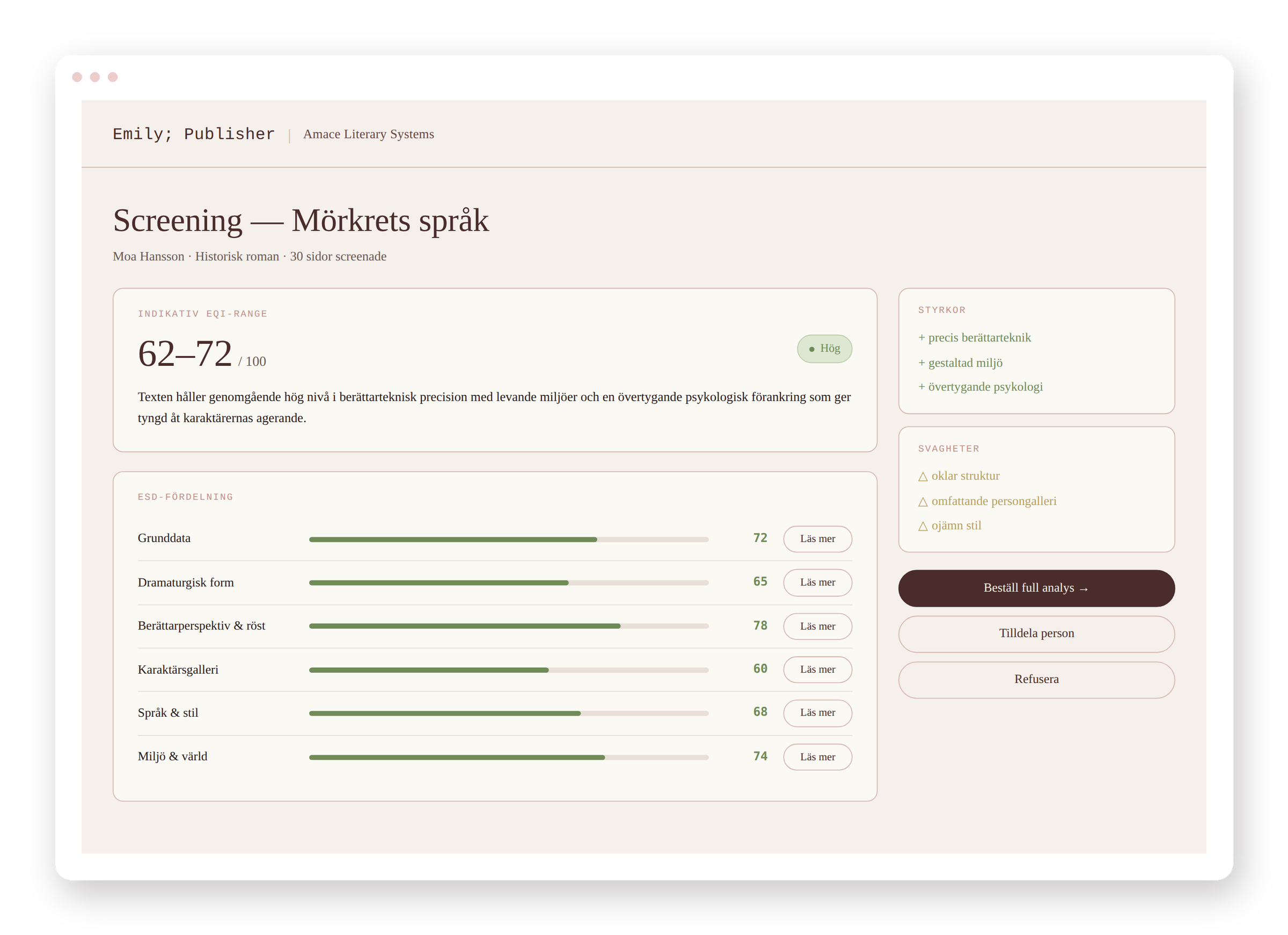
For authors
Know where your manuscript stands before it matters.
When a publisher reads your manuscript, it is assessed according to criteria developed through decades of professional editorial experience. Emily; Author gives you access to the same professional assessment criteria, translated into structured, actionable feedback.
No unpredictable or inconsistent encouragement. A professional assessment and coaching you can build on.
emily; author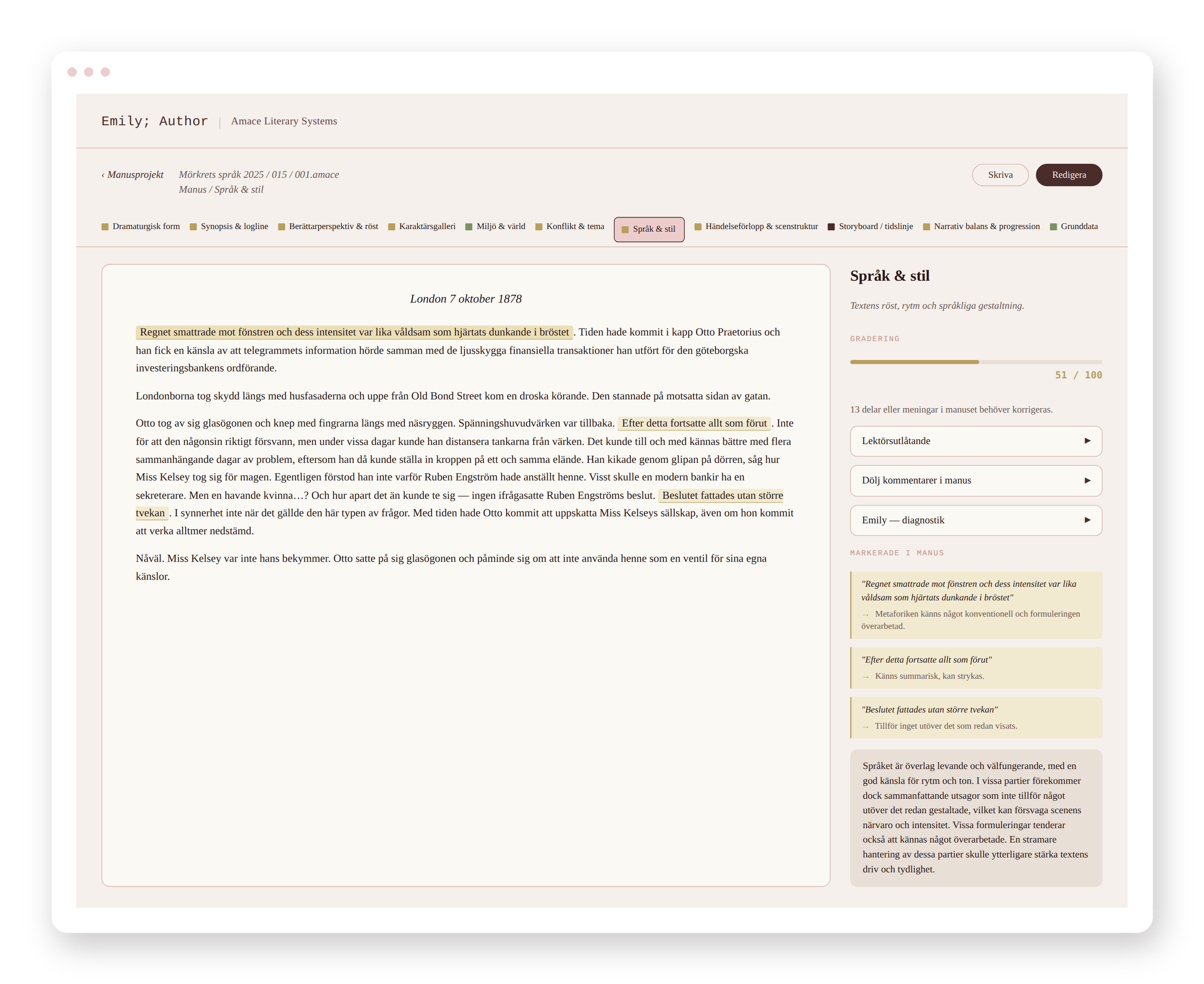
Two services.
One shared framework for literary quality.
A new category of literary intelligence.
Every experienced editor already knows what to look for in a manuscript. Emily; takes that expertise and makes it work consistently across every manuscript, every time.
The service adapts to how each publisher works. Quality dimensions can be weighted to editorial priorities, the framework can be configured to each house's workflow, and assessments become comparable across an entire inflow and over time.
Emily; applies the same literary framework to manuscript translations, showing where the text diverges from the original langugage, so editorial attention can go where it matters.
Knowing which manuscripts deserve a publisher's full attention.
what sets us apart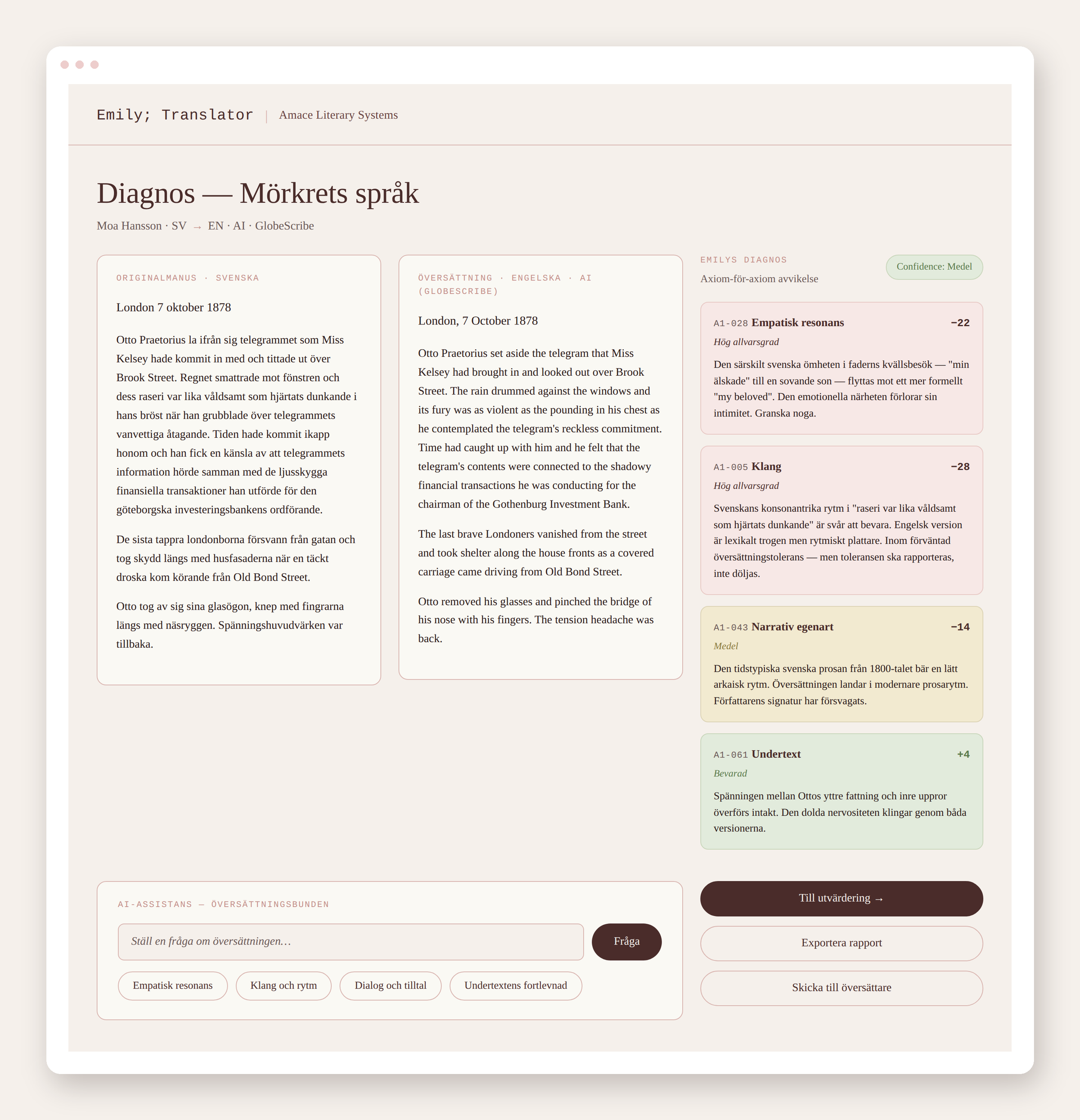
Grounded in editorial practice. Built for scale.
Emily; is developed at the intersection of editorial practice, professional manuscript assessment and technology by a team of developers, editors, authors and entrepreneurs. The framework itself is shaped in close collaboration with professional editors, distilling decades of editorial practice into defined dimensions spanning narrative architecture, language, pacing, perspective and structural coherence.
Every assessment is documented and traceable, making it possible to compare manuscripts across an entire inflow and over time. We do not replace editorial judgement. We make it more structured, traceable and scalable.
Rooted in Swedish literary expertise. Designed for the global literary market.
WHO WE ARE Editor
calibrated1-100
quality indexMinutes
not weeksMeet us at Bokmässan - Gothenburg Book Fair
September 24-27, 2026 > Booth B01:20
Booth # B01:20
Early access
We offer selected publishers, literary agents and authors early access to our services. If you are interested, we would love to hear from you.
One day Alice came to a fork in the road and saw a Cheshire Cat in a tree.
“Which road should I take?” she asked.
“Where do you want to go?” was his response.
“I don’t know.” Alice answered.
“Then it doesn’t matter which road you take,” said the Cat.Adapted from Lewis Carroll, Alice’s Adventures in Wonderland (1865)